OSF Format Description
General description of the OSF format
- Applies to format versions 4 and 5 -
The Open Streaming Format (OSF) is a binary, block-oriented data format for the continuous recording of time-related measurement and process data. It is designed not only for streaming on embedded systems with limited resources but also for the block-wise, efficient processing of large data sets on powerful analysis platforms — whether on servers, PCs, or in post-processing directly on embedded devices.
Core principles
- Time as the central axis: All data is stored with explicit time information — equidistant on a fixed grid or individually with timestamps.
- Streaming-capable: Data can be written continuously to the file during an ongoing measurement, without prior knowledge of the total amount.
- Robustness: Even after a power loss or unexpected shutdown, all data written up to the last completed block remains readable.
- Open structure: A combination of a clear metablock (XML in OSF4, JSON in OSF5) and a simple binary data stream.
- Block-wise storage: Instead of writing individual values sequentially, data blocks are used. This reduces write operations and enables fast loading of large data sets.
- Flexibility: Support for various data types — from simple scalars through vectors and matrices to binary data such as images or audio files.
- Metadata: Each channel can be described with a name, physical unit, dimension, and optional supplementary information.
Basic structure of an OSF file
Regardless of version 4 or version 5, every OSF file follows the same basic schema:
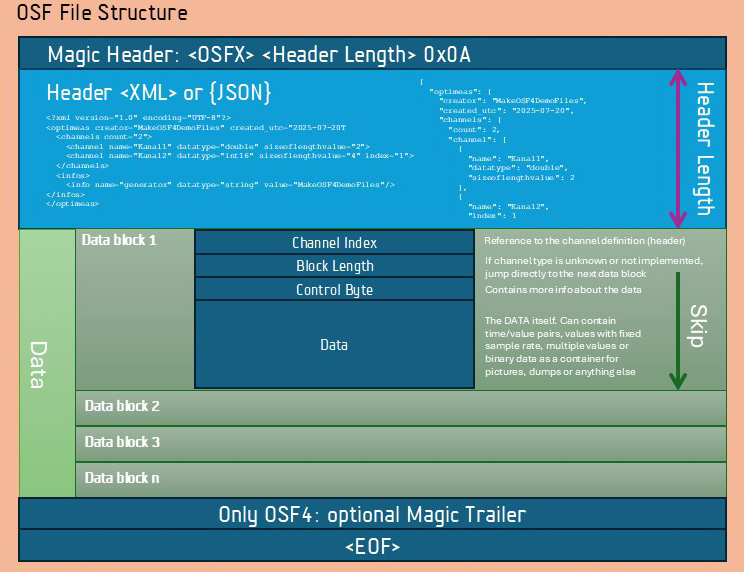
-
Magic header
- Format identifier (OSF4, OSF5, OCEAN_STREAM_FORMAT4, OCEAN_STREAMING_FORMAT4)
- Length of the following metablock
-
Metablock (XML or JSON)
- Contains information about channels, data types, physical units, and context data
- Defines the structure of the following data blocks
-
Binary data blocks
- Contain the actual measurement values in streaming format
- Support equidistant and time-stamped data
- May contain single values, vectors, matrices, or binary data
-
Optional final block
- In OSF4, an optional XML trailer with statistics and a channel overview
- In OSF5, this trailer is omitted by default
Data organization
- Channels: Each data stream is described as a channel containing a name, data type, physical unit, and optionally further attributes.
- Time base: All time values are stored in nanoseconds since epoch and enable high-precision synchronization.
- Block header: Each data block begins with a channel index and a length value, so the stream remains interpretable even with unknown channels or interruptions.
- Control byte: Defines the type and structure of the following data block (e.g. start, continuation, timestamp type). In OSF5 the use of this byte is simplified, but it remains functionally compatible.
Magic header
Every OSF file starts with the so-called magic header. It serves two purposes:
- Unique identification as an OSF file.
- Specification of the length of the following metablock so it can be read and parsed directly.
Layout
The magic header is an ASCII line terminated by a line feed (\n).
OSF4 example:
OSF4 173762\n
- OSF4 is the format identifier.
- 173762 is the length of the metablock in bytes.
OSF5 example:
OSF5 84512\n
- OSF5 identifies the new version.
- 84512 is the length of the metablock, which in OSF5 is JSON by default.
Supported identifiers
For compatibility, OSF implementations recognize multiple headers:
- OSF4 — classic OSF4 file
- OCEAN_STREAM_FORMAT4 — legacy identifier for OSF4 files; still emitted by deployed devices and therefore must be accepted by readers
- OCEAN_STREAMING_FORMAT4 — older historical spelling; also to be interpreted as OSF4
- OSF5 — OSF5 file
Header tokens (optional trailing fields)
The OSF5 header line MAY carry optional, whitespace-separated tokens after the metablock length:
header-line = identifier SP metablock-len *(SP token) LF
token       = key ":" value
Here key consists of lowercase a-z, digits 0-9, and the hyphen -;
value is non-space visible characters. Exactly one space separates the
fields; there is no trailing space before the LF.
Tokens are "must understand": if a reader encounters a key it does not
know, it MUST reject the file — with a diagnostic such as
unknown header token '<key>', not as a number-parse error.
Tokens are an OSF5-only feature: the OSF4 legacy identifiers (OSF4,
OCEAN_STREAM_FORMAT4, OCEAN_STREAMING_FORMAT4) MUST NOT carry tokens; a
token after an OSF4 identifier is a malformed file.
The defined keys (crc32c, ed25519) and their meaning are specified in the
integrity profile — see
OSF5 Integrity Profile.
Detection of the metablock format
Whether the following metablock is XML or JSON is determined by the first character after the header:
<→ XML (OSF4 format){→ JSON (OSF5 format)- Any other character → error
Advantages
- Fast start: Readers can immediately extract the metablock and pass it to the appropriate parser.
- Streaming-capable: No knowledge of the total file size is required.
- Backward-compatible: OSF5 processes OSF4 files (including OCEAN_STREAM_FORMAT4 and OCEAN_STREAMING_FORMAT4).
- Simple implementation: A single line is sufficient to determine version and parser.
The following describes the metablock for OSF4 and OSF5 in general, without XML/JSON specifics and without vector/matrix parameters:
Metablock — channels and metadata
Directly after the magic header, every OSF file contains the metablock. It contains all information needed to interpret the following data blocks correctly. This includes:
- File parameters: Context information about the file and its origin.
- Channel definitions: Describe each data stream with a name, data type, and physical properties.
- Metadata: Additional information not directly tied to a channel (e.g. system status, comments, calibration data).
The metablock acts as the file's "table of contents" and is designed to be unambiguous, machine-readable, and easy to extend.
File parameters (in the metablock)
- created_utc — File creation time in UTC, ISO 8601 format
- creator —
optionalIdentification of the producer (e.g. device serial number, program name, UUID) - created_at_longitude / created_at_latitude / created_at_altitude —
optionalgeographic position at the time of file creation - reason —
optionalreason for file creation (e.g.BOOT,SEQUENCE,TRIGGERED) - total_seq_no —
deprecatedAbsolute sequence number since system start (starting at 0) - triggered_seq_no —
deprecatedRelative sequence number since the last trigger event (starting at 0) - namespacesep —
optionalSeparator for hierarchical channel names (default".") - tag —
optionalFree tag for classifying the file (e.g.preview) - comment —
optionalOptional comment text
Channel definitions (channel)
Each channel describes one data stream within the file. The parameters are described below.
Identification and organization
- index Unique channel index within the file (starting at 0).
- name
Channel name, optionally with a hierarchical path (e.g.
Motor.Temperature). - reference Optional unique reference or UUID identifying the data origin.
Time base
-
timeincrement Fixed time increment in nanoseconds for equidistant channels. Value = 0 or unset → channel uses per-value timestamps.
Note: The
timeincrementin the metablock is an optional hint. For high-resolution or trigger-based recordings, the exact sample rate is often unknown when the header is created. The effective sample rate is delivered in everybcStartDatablock as adoubleand applies from that point on to all subsequentbcContinuedDatablocks of the same channel, until a newbcStartDatablock is written. This applies to OSF4 as well as OSF5.
Data types and structure
-
datatype Data type of the stored values (e.g.
bool,int32,double,string,gpslocation). → A complete description of all data types and their encoding is in the Data types chapter. -
channeltype Structural type of the channel:
scalar— single values over timebinary— arbitrary binary blocks (e.g. images) (Vector and matrix are described in a separate document.) → A detailed explanation of channel types is in the Channel types chapter.
-
sizeoflengthvalue Size of the length value preceding each data block:
2→ 2 bytes (uint16, max. block size ~64 kB)4→ 4 bytes (uint32, max. block size ~4 GB) Used to determine the block size and to read data blocks correctly from the stream. → A detailed explanation is in the sizeoflengthvalue chapter.
-
mimetype Optional, MIME type for binary channels (e.g.
image/jpeg,audio/wav). -
spectrumtype Optional, type of spectral data:
amplitude(default)realImagampPhaseRadampPhaseDeg
Physical properties
- physicalunit
Optional, physical unit (SI-compliant, e.g.
V,°C). - physicaldimension
Optional, description of the physical dimension (
temperature,pressure, …).
Display and supplementary info
- displayname Optional display name for visualization or GUI use.
- comment Optional comment for the channel.
Metadata (info)
Metadata supplements the file with additional information not bound to a channel. Typical parameters:
- name — Name of the information item
- value — Value (as string or typed)
- datatype — Type of the value (
string,int32,float,binary,gpslocation, etc.) - physicalunit — Optional, physical unit of the value
Metadata is freely definable and is suited for:
- System or device data
- Comments and status messages
- Calibration values
- User-defined supplementary information
Note:
bytearrayis an alias forbinary. Both names are valid in OSF4 and OSF5 and are interpreted identically by readers. Writers should usebinaryconsistently when writing;bytearrayremains readable for backward compatibility.
Advantages of the structure
- Clear separation of data and description: The metablock defines how data is interpreted without containing measurement values itself.
- Self-describing: Files can be read and interpreted without external definitions.
- Extensible: New channels, data types, or metadata can be added without changing the basic format.
- Robust: Fixed indices and length values keep the file interpretable even when not all channels are known.
Core parameters of the channel description
The following parameters define the basic structure of a channel in OSF and determine how data is stored and interpreted in the streaming format. They are relevant for all channels and form the foundation of the channel description.
Data types (datatype)
The datatype parameter defines the data format of a channel's values. Each value is stored in a precisely defined binary format.
Supported data types and encoding:
| Data type | Size (bytes) | Description |
|---|---|---|
bool | 1 | True/false (0 = false, 1 = true) |
int8 | 1 | Signed integer |
int16 | 2 | Signed integer |
int32 | 4 | Signed integer |
int64 | 8 | Signed integer |
uint8 | 1 | Unsigned integer, range 0 … 255 |
uint16 | 2 | Unsigned integer, range 0 … 65 535 |
uint32 | 4 | Unsigned integer, range 0 … 4 294 967 295 |
uint64 | 8 | Unsigned integer, range 0 … 18 446 744 073 709 551 615 |
float | 4 | IEEE 754 single precision |
double | 8 | IEEE 754 double precision |
string | variable | UTF-8 encoded, length defined by block size. On disk in bcAbsTimeStampData: followed by a trailing null byte (0x00) in OSF4, no trailing byte in OSF5 — see the note block below for the rules. bcMessageEvent payloads are length-prefixed instead and never null-terminated, in either version. |
binary (alias: bytearray) | variable | Arbitrary byte sequences for image, audio, or other binary data with a MIME type. The maximum block size is determined by the channel's sizeoflengthvalue field. On disk in bcAbsTimeStampData: followed by a trailing null byte (0x00) in OSF4, no trailing byte in OSF5 — see the note block below for the rules. bcMessageEvent payloads are length-prefixed instead and never null-terminated, in either version. |
gpslocation | 24 | Structure for GPS positions (see below) |
Note on integer types: Integer values (
int8,int16,int32,int64,uint8,uint16,uint32,uint64) are typically used in OSF files for states, status information, or counter values, not as scaled raw values of a physical quantity. For this reason OSF deliberately has noscale/offsetparameters for conversion to physical values — physical quantities are stored directly asfloatordouble.
Note on null termination of string and binary
Note on null termination of
stringandbinary: The trailing0x00byte onstringandbinarypayloads inbcAbsTimeStampDatais a historical artefact from the QtQStringserialisation used in the original Optimeas devices. The block length is already determined bysizeoflengthvalue, so a null-terminator as a sentinel is redundant. For binary payloads it is an active stumbling block: a reader that leaves the trailing byte in place produces invalid output (a JPEG file with a trailing0x00is no longer a valid JPEG). Equally, a reader that strips a byte from an OSF5 binary payload that never had one (an ASN.1 blob that legitimately ends in0x00, a protobuf message, a null-terminated string stored as binary) cuts off a real data byte. The rule is therefore tied to the on-disk format version, so neither writers nor readers have to guess.OSF4:
- Writers MUST append a single trailing
0x00byte after everystringandbinarypayload inbcAbsTimeStampData.- Readers MUST strip the last byte of the payload unconditionally — the byte is guaranteed to be present.
OSF5:
- Writers MUST NOT append any trailing byte. The payload ends at the last data byte;
sizeoflengthvaluedefines the exact length.- Readers MUST NOT strip any trailing byte. A trailing
0x00is treated as a regular data byte.The effective payload length is therefore: block length in OSF5, block length minus one byte in OSF4. There is no heuristic and no sentinel-detection step.
gpslocation structure
struct gps_location {
    double latitude;   // Latitude
    double longitude;  // Longitude
    double altitude;   // Altitude
};
Note: For channels with
datatype="binary"it is recommended to define the MIME type (mimetype) on the channel (e.g.image/jpeg,audio/wav) so the data can be interpreted unambiguously. The maximum block size is determined by the channel'ssizeoflengthvalueparameter.
Channel types (channeltype)
The channeltype parameter defines the logical organization of a channel's values (its data shape). It specifies how many values are stored per data block and what structure those values have.
Important:
channeltypeis the data shape, not the storage/sampling mode. Whether a channel is equidistant or timestamped is derived from the block control byte (bcStartData/bcContinuedData⇒ equidistant;bcAbsTimeStampData⇒ per-value timestamps) together withtimeincrement— not fromchanneltype.equidistantandtimestampedare therefore notchanneltypevalues and must not be written as such.
OSF defines the following channel types (scalar, vector, matrix, binary — see also the field description under Data types and structure and osf4.md):
scalar
-
Description: A channel with exactly one value per point in time. Typical use: continuous physical quantities (temperature, voltage, pressure) or digital signals (e.g. door status).
-
Properties:
- Each data block contains one or more samples with a single value.
- Supports equidistant sampling via
timeincrementor per-value timestamps. - The simplest and most frequently used channel type.
-
XML example (OSF4):
<channelindex="0"name="Sensor.Temperature"channeltype="scalar"datatype="double"physicalunit="°C"/> -
JSON example (OSF5):
{"index": 0,"name": "Sensor.Temperature","channeltype": "scalar","datatype": "double","physicalunit": "°C"}
vector
-
Description: A channel in which each data block contains a sequence of multiple values that logically belong together. Typical use: frequency spectra (FFT), time-series segments, multi-channel recordings in one block.
-
Properties:
- Vector length may vary per block.
- Reduces overhead at high sample rates because multiple values are written per block.
- Can be used with per-block timestamps or with a fixed time increment.
- Requires additional parameters for axis information (separate document).
-
XML example (OSF4):
<channelindex="2"name="FFT.Magnitude"channeltype="vector"datatype="float"physicalunit="dB"/> -
JSON example (OSF5):
{"index": 2,"name": "FFT.Magnitude","channeltype": "vector","datatype": "float","physicalunit": "dB"}
matrix
-
Description: A channel that stores a two-dimensional data structure per timestamp. Typical use: rainflow classifications, heatmaps, 2D sensor arrays, image data.
-
Properties:
- Matrix size may vary per block.
- Enables complex data structures on a unified time base.
- Requires additional parameters for row and column descriptions (separate document).
-
XML example (OSF4):
<channelindex="5"name="Rainflow.Matrix"channeltype="matrix"datatype="int32"physicalunit="counts"/> -
JSON example (OSF5):
{"index": 5,"name": "Rainflow.Matrix","channeltype": "matrix","datatype": "int32","physicalunit": "counts"}
binary
-
Description: A channel that stores an arbitrary binary block per point in time (one blob per value). Typical use: images, audio clips, serialized messages.
-
Properties:
- Payload-equivalent to a
scalarchannel withdatatype="binary"; a reader treats both spellings identically. - Setting the channel's
mimetypeis recommended (e.g.image/jpeg). - The maximum block size is determined by
sizeoflengthvalue.
- Payload-equivalent to a
-
JSON example (OSF5):
{"index": 3,"name": "Camera.Frame","channeltype": "binary","datatype": "binary","mimetype": "image/jpeg"}
Notes on vector and matrix
- Additional parameters: Both types require metadata about dimensions, axes, physical units, and optionally labels. These are described in detail in dedicated documents.
- Efficiency: Vector and matrix channels reduce write operations and are particularly suited for data with high sample rates or complex structure.
- Flexibility: Block size and structure may vary, allowing adaptation to different measurement scenarios.
- Synchronization: They share the same time base as scalar channels, so different data types can be stored exactly synchronized in one file.
Summary
binary— An arbitrary binary block per point in time (images, audio, serialized messages); equivalent toscalar+datatype="binary".scalar— Simple channel type, one value per point in time. Ideal for continuous measurement values.vector— Multiple values per block, optimized for frequency spectra and high-frequency data.matrix— Multi-dimensional blocks, suited for classifications, image, and array data.
Note: By combining these channel types, OSF covers both simple signals and complex data sets while remaining easy to implement.
Block size field (sizeoflengthvalue)
The sizeoflengthvalue parameter defines the size of the length field that precedes each data block of a channel. It specifies how many bytes are used to express the block size and therefore the maximum size of a single data block.
Purpose
OSF is a streaming format. Each data block can be of a different size and contains a variable number of measurement values. To read these blocks correctly, their length must be known. The sizeoflengthvalue field specifies whether the length value uses 2 bytes or 4 bytes.
Values
-
2 — length field is 2 bytes (uint16).
- Maximum value: 65,535 bytes per data block.
- Default for typical measurement channels with moderate block sizes.
- Lower memory footprint and overhead.
-
4 — length field is 4 bytes (uint32).
- Maximum value: ~4 GB per data block.
- Suited for channels with very large data packets, e.g. image, audio, or binary data.
Default value
If not specified explicitly, sizeoflengthvalue="2" is used.
Effects
- Memory footprint: 2 bytes save space for small blocks; 4 bytes enable large data.
- Readability: Before interpreting a block, the reader must read the length value and treat the next
Nbytes as the block. - Robustness: Even if writing was interrupted, the reader can correctly skip blocks and find the next valid block.
Recommendations
- For continuous signals and channels with scalar values → use
2. - For binary channels with images, audio, or large data packets → choose
4. - Use a consistent choice per channel; it can be set per channel in the channel definition.
Data blocks
Data blocks are the heart of the OSF format. They contain the actual measurement values and are structured so that they can be written and read efficiently both during continuous streaming on embedded systems and during block-wise processing on servers and PCs. Each data block is self-contained and remains interpretable even if the recording is aborted.
Introduction
In OSF, all measurement values are stored in data blocks. Each block is a self-contained unit that contains one or more values of a channel and is associated with time information.
The block concept enables two central properties of the format:
- Continuous streaming: Values can be written sequentially during recording without knowing the entire file structure.
- Efficient processing: Block-wise storage allows fast loading and processing of large data sets on servers, PCs, or in post-processing.
Each data block is designed so that even after a sudden interruption of the measurement (e.g. power loss) it remains readable up to the last fully written unit.
The data block structure is identical in OSF4 and OSF5 and forms the basis for robust, lossless recording of time-related measurement data.
General structure of a data block
A data block in OSF consists of a fixed header structure followed by optional metadata and the actual measurement values.
The layout is designed so that each block can be interpreted independently and remains valid even during streaming or after a file abort.
Basic structure:
-
Channel index (
uint16)- Identifies which channel the data belongs to.
- Corresponds to the
indexattribute in the metablock.
-
Length field (
uint16oruint32)- Size of the following block content — control byte plus data area (at OSF5 integrity level
crcincluding the trailing frame CRC) — in bytes. - The width of the field is defined by the channel parameter
sizeoflengthvalue. - Allows blocks to be skipped or, on errors, to jump correctly to the next unit.
- Size of the following block content — control byte plus data area (at OSF5 integrity level
-
Control byte (
uint8)- Defines the type of the data block and contains information about the structure of the following data.
- The most significant bit (bit 7) indicates whether the block contains a single value (0) or multiple values (1).
- A complete overview of control byte values is in the Control byte section.
-
Data area
- The actual measurement values or data.
- Format and size depend on the channel type (typically scalar) and the data type.
Zero-length data blocks (non-conforming)
This rule applies to OSF4 and OSF5 alike — the block framing is identical in both format versions.
Every data block carries at least its control byte, so a length field
literally read as 0 from the stream never occurs in a conforming file. Under
OSF5 integrity level crc the length field is never below 5, because the
4-byte frame CRC is counted inside the length field (see
OSF5 Integrity Profile).
- Writers MUST NOT emit a data block whose length field is
0. - Readers MUST NOT treat a length field literally read as
0as a truncation, and MUST NOT abort the read. The block consists solely of the channel index and the length field, both of which the reader has already consumed. The reader skips the block, counts it as a skipped block with the reasonZeroLengthBlock, and continues scanning at the next channel index. - The
0test precedes the CRC-length test at every integrity level. A length field literally read as0is always classified asZeroLengthBlock, never as a CRC failure. A length of1–4under levelcrcis a broken block and stays a CRC-level concern, not a zero-length block. - The anomaly MUST be visible in the reader's statistics through a counter of its own, so that a non-conforming file can be diagnosed rather than silently tolerated.
Reading always makes progress: each such block consumes 4 or 6 bytes (a
uint16 channel index plus a 2- or 4-byte length field), so a run of
zero-length blocks cannot stall the reader.
The control byte
Every data block in OSF contains a control byte (blockContent) that determines the block type and the structure of the contained data.
In addition, the most significant bit (bit 7) indicates whether the block contains only a single value or multiple values:
- Bit 7 = 0 → A single value in the block.
- Bit 7 = 1 → Multiple values in the block (N > 1).
The control byte is interpreted as an 8-bit value. The lower 7 bits define the block type, the highest bit defines the number of values.
Overview of block types
| Value (0–8) | Enum | Meaning | Data block content |
|---|---|---|---|
| 0 | bcReserved | Reserved for future use. Originally bcMetaData, never used. | Variable, internal special functions |
| 1 | bcTrustedTimestamp | Deprecated Originally intended for constant values with a "valid until" timestamp. Recommendation: have the application set sample points instead. | int64: absolute timestamp (ns since epoch) |
| 2 | bcTimebaseRealign | Deprecated Time-axis adjustment. Can be replaced if needed by writing a new block with an absolute start time. | int64: absolute timestampint64: time shift (ns) |
| 3 | bcStatusEvent | Deprecated Used to carry per-channel status information. No longer used. Unlike bcMessageEvent, its payload is a fixed status word rather than a value of the channel's datatype, so it is never decoded as a channel sample. Readers MUST count it under a reason of its own, distinct from the generic deprecated-skip bucket, so an occurrence in the field stays visible. | int64: absolute timestampuint32: status word |
| 4 | bcMessageEvent | Deprecated, must be read Still emitted by deployed devices for string channels in OSF4 — a conforming encoding there, since the specification only stops the type from being produced from OSF5 onward. Can be fully replaced by bcAbsTimeStampData with the same datatype. Readers MUST decode it as one time-stamped sample of the channel's datatype; writers MUST NOT emit it. Bit 7 on this block type is unspecified and MUST NOT be interpreted: a reader encountering it treats the block as unknown, skips it via the length field, counts it, and continues (full layout and edge cases below). | int64: absolute timestampuint32: payload length NN bytes of payload, interpreted per the channel's datatype — defined only for string and binary (see below). No trailing 0x00 — the payload is length-prefixed, so the OSF4 null-terminator rule of bcAbsTimeStampData does not apply. |
| 5 | bcContinuedData | Continue equidistant data with a fixed sample rate. With bit 7 set, multiple values per block. | [uint32 N]: number of samples (only if bit 7 set)N × data values |
| 6 | bcStartData | First data block with a fixed sample rate; additionally carries the sample rate effective from this block onward (e.g. on a trigger). Always contains an absolute start timestamp. | int64: absolute timestampdouble: sample rate (Hz)[uint32 N]: number of samples (only if bit 7 set)N × data values |
| 7 | bcContinuedRelStampData | Deprecated, supported on read in OSF5 Originally used to save 4 bytes per sample with relative timestamps. | [uint32 N]: number of samples (only if bit 7 set)N × (uint32 relative time + data value) |
| 8 | bcAbsTimeStampData | Data blocks with an absolute timestamp per value. Now also supports strings and binary data in combination with datatype and mimetype. | [uint32 N]: number of samples (only if bit 7 set)N × (int64 absolute time + data value) |
Block-type restrictions with respect to channel information:
| Enum type | Equidistant data | Time-stamped data |
|---|---|---|
| bcStartData | allowed | not allowed |
| bcContinuedData | allowed | not allowed |
| bcContinuedRelStampData | not allowed | allowed |
| bcAbsTimeStampData | not allowed | allowed |
| bcMessageEvent | not allowed | allowed |
Data structure per control type
The structure of the payload in a block depends directly on the control type.
The following sections describe how values are stored for the various data types and which restrictions apply.
bcStartData (equidistant data, start block)
-
Use:
- Beginning of a data series with a fixed sample rate.
- Always contains the absolute start time of the series.
- Allowed only for numeric
datatype(int*,float,double).
-
Block layout:
int64— absolute start timestamp (ns since epoch).double— sample rate in Hz (effective from this block until the nextbcStartData).- [uint32 N] — number of samples (only if bit 7 is set, otherwise 1).
- N × data values — raw data according to
datatype.
-
Example
datatype=double: [int64 StartTime] [double SampleRate] [uint32 N] [double Value1] [double Value2] ... [double ValueN] -
Notes:
bcStartDatamay appear multiple times per file and channel. It is written:- at the start of an equidistant recording,
- on every trigger or event that starts a new data sequence,
- on a required time-track correction (drift compensation).
- Consequence for readers: Data of an equidistant channel is produced block- or event-wise. Time gaps may occur between consecutive sequences of the same channel. Readers must take the effective sample rate from the currently active
bcStartDatablock and must not assume thattimeincrementfrom the metablock is always correct.
bcContinuedData (equidistant data, continuation)
-
Use:
- Continues a series started by
bcStartDatawithout a new timestamp. - The first value follows directly after the last value of the previous block.
- Allowed only for numeric
datatype(int*,float,double).
- Continues a series started by
-
Block layout:
- [uint32 N] — number of samples (only if bit 7 is set, otherwise 1).
- N × data values — raw data according to
datatype.
-
Example
datatype=int16: [uint32 N] [int16 Value1] [int16 Value2] ... [int16 ValueN] -
Note: The time per sample in a
bcContinuedDatablock is1 / SampleRatefrom the most recently readbcStartDatablock of the same channel.
bcAbsTimeStampData (time-stamped data)
-
Use:
- For channels with per-value timestamps.
- Supports all
datatypevalues, includingstringandbinary.
-
Block layout:
- [uint32 N] — number of samples (only if bit 7 is set, otherwise 1).
- N × (int64 time + data value) — absolute timestamp + value.
-
Example
datatype=int16: [uint32 N] [int64 Time1] [int16 Value1] [int64 Time2] [int16 Value2] ... -
Example
datatype=double: [uint32 N] [int64 Time1] [double Value1] [int64 Time2] [double Value2] ... -
Example
datatype=string:- Strings are stored as raw UTF-8 bytes. The effective string length is the payload length of the data field, minus one byte in OSF4 (the spec-mandated trailing
0x00) or the full payload length in OSF5 (see the note block above for the full rules). - Single-sample form (bit 7 = 0, N implicit 1): [int64 Time] [UTF-8 bytes of the string]
- Multi-sample form (bit 7 = 1) for variable-length types is not part of the standard wire format; see the note on multi-sample variable-length blocks below.
- Strings are stored as raw UTF-8 bytes. The effective string length is the payload length of the data field, minus one byte in OSF4 (the spec-mandated trailing
-
Example
datatype=binary:- Binary data is written as raw bytes. The channel's
mimetypedefines the interpretation. The effective payload length is the data field's payload length, minus one byte in OSF4 (the spec-mandated trailing0x00) or the full payload length in OSF5 (see the note block above for the full rules). - Single-sample form (bit 7 = 0, N implicit 1): [int64 Time] [Byte1] [Byte2] ... [Byte M]
- Multi-sample form (bit 7 = 1) for variable-length types is not part of the standard wire format; see the note on multi-sample variable-length blocks below.
- Binary data is written as raw bytes. The channel's
Multi-sample variable-length blocks. For
stringandbinarydata inbcAbsTimeStampData, writers should emit one sample per block (N=1). The multi-sample form (Bit 7 = 1 with N > 1) for variable-length types is not part of the standard wire format. Readers may encounter multi-sample variable-length blocks from older or non-standard writers; reader behavior in that case is implementation-defined. The Rust and C++ reference readers accept equal-length-segments-per-sample layouts only; the Delphi historical writer uses a per-sampleuint32length prefix that other readers do not parse.
- Note: With multiple samples per block (
N>1), numeric types must have a fixed wire size per sample. Multi-sample variable-length blocks are not standard; see the note on multi-sample variable-length blocks above.
bcContinuedRelStampData (time-stamped, relative)
-
Use:
- For channels with per-value timestamps and relative intervals.
- No longer used from OSF5 onwards, but remains for OSF4 readers.
-
Block layout:
- [uint32 N] — number of samples (only if bit 7 is set, otherwise 1).
- N × (uint32 Δt + data value) — relative time interval in ns + value.
-
Example
datatype=int16: [uint32 N] [uint32 Δt1] [int16 Value1] [uint32 Δt2] [int16 Value2] ... -
See bcAbsTimeStampData for further examples.
-
Note:
-
Originally introduced to save 4 bytes per sample.
-
Removed in OSF5 in favor of a simpler implementation.
bcMessageEvent (deprecated, read-mandatory)
-
Use:
- Historical encoding for a time-stamped
stringorbinaryvalue; can be fully replaced bybcAbsTimeStampDatawith the samedatatype. - Deployed device firmware still emits it for
stringchannels in OSF4 — a conforming encoding there, since the specification only stops the type from being produced from OSF5 onward. Readers of every format version MUST decode it, because files carrying it exist in the field. Writers MUST NOT emit it.
- Historical encoding for a time-stamped
-
Block layout:
int64— absolute timestamp (ns since epoch).uint32— payload length N (bytes).Nbytes of payload, interpreted per the channel'sdatatype.
-
Example
datatype=string: [int64 Time] [uint32 N] [N bytes of UTF-8 payload] -
No trailing
0x00. The payload is length-prefixed byN, so the OSF4 null-terminator rule that governsbcAbsTimeStampData(see the note block on null-byte handling) does not apply here — there was never a byte to strip. Only the value interpretation ofstring/binarypayloads is shared withbcAbsTimeStampData; the framing is not. -
datatypescope. Onlydatatype=stringanddatatype=binaryare defined over this block type. On any otherdatatype, readers MUST skip the block via its length field and count it — they MUST NOT raise an error or fail the file. Skipping keeps the rest of a real recording readable; failing would reintroduce, in a new place, the class of defect the zero-length-block rule closed. -
N = 0is legal and decodes to an empty value (an empty string, or a zero-length binary payload) — not an error. This is not the zero-length data block anomaly: there, the block's length field itself is0and no control byte is ever read; here the length field reflects the true frame size (1 + 8 + 4 + Nbytes) and only the payload happens to be empty. -
Bit 7 (multi-value) is unspecified for this block type. It has never been observed set in the field, and no multi-sample layout is defined for it. A reader encountering it MUST NOT interpret it: it treats the block as an unknown type, skips it via the length field, counts it, and continues — the same conservative handling as any other unrecognized shape.
Restrictions
-
Equidistant channels (bcStartData, bcContinuedData):
- Only direct numeric data types (
int*,float,double). - No strings, no binary data, no complex structures.
- Only direct numeric data types (
-
Time-stamped channels (bcAbsTimeStampData, bcContinuedRelStampData):
- Support all data types.
- Strings and binary data carry a trailing
0x00byte in OSF4 (stripped by readers) and no trailing byte in OSF5; see the note block on null-byte handling for the deterministic rules.
Important points
-
Compatibility:
- OSF5 can read all OSF4 block types.
- From OSF5 onwards,
bcContinuedRelStampData,bcStatusEvent, andbcMessageEventare no longer produced. Not being produced does not mean not being read:bcContinuedRelStampDataandbcMessageEventremain read-mandatory in every version, because files carrying them exist in the field. bcTrustedTimestampis ignored and is marked as deprecated.
-
Implementation:
- Readers must always check bit 7 to correctly interpret single- vs. multi-value blocks.
- Unrecognized block types can be skipped using the length value.
-
Strings and binary data:
- For
bcAbsTimeStampDatawithdatatype=stringordatatype=binary, the trailing null byte (0x00) is always present in OSF4 (writer must append, reader must strip) and never present in OSF5 (writer must not append, reader must not strip). See the note block on null-byte handling for the full rules. - The block length is determined by
sizeoflengthvalue. - Binary data uses
datatype=binaryplusmimetype.
- For
File completion and magic trailer
Optionally, an info data block with the special channel index 0xFFFF may be written at the end of an OSF file.
This block provides metadata about the completed data stream and marks the regular end of the file.
Info data block (channel index 0xFFFF)
-
Purpose:
Provides a quick overview of the time interval and segmentation of the file without having to read all data blocks.
Useful for analysis and indexing tools. -
Layout:
uint16— channel index (0xFFFF)uint32— length of the following options blockuint8— control byte (alwaysbcReserved/ 0)string— UTF-8-encoded info block (format depends on the OSF version)
Example (OSF4, XML):
<trailer finalized_utc="2019-08-12T12:23:01+02:00" reason="fileStartGrid_min">
    <channels count="8">
        <channel index="0" samples="29452" last_ns="1384899599997800000" last_utc="2019-11-19T23:19:59"/>
        <channel index="1" samples="29452" last_ns="1384899599997800000" last_utc="2019-11-19T23:19:59"/>
        <channel index="2" samples="29452" last_ns="1384899599997800000" last_utc="2019-11-19T23:19:59"/>
        <channel index="3" samples="29452" last_ns="1384899599997800000" last_utc="2019-11-19T23:19:59"/>
    </channels>
</trailer>
Example (OSF5, JSON):
{
  "trailer": {
    "finalized_utc": "2019-08-12T12:23:01+02:00",
    "reason": "fileStartGrid_min",
    "channels": [
      {
        "index": 0,
        "samples": 29452,
        "last_ns": 1384899599997800000,
        "last_utc": "2019-11-19T23:19:59"
      },
      {
        "index": 1,
        "samples": 29452,
        "last_ns": 1384899599997800000,
        "last_utc": "2019-11-19T23:19:59"
      }
    ]
  }
}
-
Note:
- OSF4 uses XML by default for the info block.
- OSF5 uses JSON, but for compatibility can read XML as well, although it never writes XML.
Magic trailer
Optionally, a magic trailer may follow the info data block.
It serves as a fixed marker for the end of the file and indicates where the 0xFFFF block begins.
- Format:
OSF_STREAM_END 321316454==============
- The number is the position in the file at which the
0xFFFFblock starts. - The trailer tag is padded to 40 bytes, with
=characters appended after the number until the length is reached.
Purpose of the magic trailer
- Allows the info data block at the end of the file to be located without searching the entire file.
- Eases random-access implementations and indexing of large files.
- Provides a clear marker for the regular end of an OSF file.
Optionality and implementation effort
-
Writing:
- The info block and the magic trailer are not strictly required.
- If written, they enable fast indexing and determination of the file's time interval.
- On embedded systems with tight resources they can be omitted.
-
Reading:
- Parsers must not assume the block is present.
- Files without a trailer are interpreted up to the last fully readable block.
- On a hard abort, the last block may be shorter than its length value indicates — in that case the reader must stop at the end of the file.
Advantages
- Quick determination of the time interval and statistics without reading the entire file.
- Useful for long measurements and automated analysis.
- Enables random access for analysis tools.
Disadvantages
- Higher implementation effort for writing and reading.
- On a file abort, the trailer may be missing or incomplete.
- Not strictly necessary for simple streaming.
OSFZ — Compressed OSF files
OSF files may be compressed for storage or transport. Compressed
files typically use the .osfz extension and contain a complete
OSF file (OSF4 or OSF5) as the compressed payload. There is no
dedicated OSFZ magic header — detection is based on the compression
magic bytes at the start of the file.
Supported compression formats
Readers must transparently detect and decompress both common compression formats:
| Format | Magic bytes | Specification |
|---|---|---|
| gzip | 0x1F 0x8B | RFC 1952 |
| zlib | 0x78 0x01, 0x78 0x5E, 0x78 0x9C, 0x78 0xDA | RFC 1950 |
Both formats occur in practice: current Optimeas devices write gzip-compressed OSFZ files; older tooling and storage pipelines use zlib. An implementation supporting only one of the two would fail on real field data.
Detection
Detection is based on the first two bytes of the file:
0x1F 0x8B→ gzip decompression0x78 0x01 / 0x5E / 0x9C / 0xDA→ zlib decompression- otherwise → uncompressed, read the file as OSF directly
After decompression, the file begins with a regular OSF magic
header (OSF4, OSF5, OCEAN_STREAM_FORMAT4, or
OCEAN_STREAMING_FORMAT4).
Writing
Writers MAY produce OSFZ output. When they do, the compressed container is gzip (RFC 1952).
Streaming writers (those that write blocks incrementally with per-block
fsync) must treat compression as a post-finalization step, decoupled
from the write path. Compressing inline would make a power-loss truncation
undecompressable and defeat the best-effort durability guarantee. The
compression step runs after the writer is closed, either as a low-priority
background thread (the process must not exit before it completes) or as an
external CLI process. The source OSF file must be retained until the OSFZ
has been successfully written and fsync'd; no read-back verification is
required before deletion.
Block writers (those that buffer the entire file in memory and write it atomically) MAY compress inline and emit OSFZ directly, because there is no partial-stream or power-loss truncation risk.
Next steps
The chapter so far describes the general layout of the Open Streaming Format (OSF) and all components that apply to OSF4 and OSF5 alike.
For a complete implementation or deeper integration, the following further topics are available:
-
OSF4 and OSF5 specifics:
-
Vectors and matrices:
- Extended channel types for multi-dimensional data
- Additional parameters for axes, dimensions, and physical units
- Examples for FFTs, classifications, and image data
-
Examples:
- Complete OSF files (OSF4/XML and OSF5/JSON) with header, metablock, and data blocks
- Hex dumps and annotated structures
-
Source-code access and open source:
- Reference implementations for OSF4 and OSF5
- Parser and writer libraries for various platforms
- Sample code for embedded systems and PC analysis
This document is licensed under CC BY 4.0. Attribution: optiMEAS GmbH and optiMEAS Switzerland GmbH.